Kelly Fruit Company
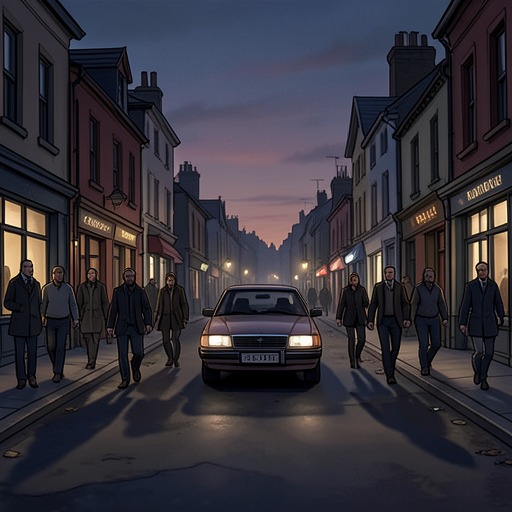
Stephen King Three Classic Novels Box Set: Carrie, 'Salem's Lot, the ShiningKelly Fruit Company is the closest thing Chamberlain has to a high-school hangout, a modest public space where teenagers wait, drink, read, flirt, and avoid one another under the loose supervision of its proprietor, Hubert Kelly. Its importance is less architectural than social: before the destruction of Chamberlain, Kelly’s gathers the town’s everyday routines into one cramped setting, and afterward its shattered windows and burned premises become evidence of how completely the disaster has crossed from the school into the town itself.
Setting and Character
Kelly Fruit Company stands in The Center, serving a community too loosely sprawled to possess a single, formal youth center. The place has taken on that role by default after Sheriff Doyle closed the recreation center following a large drug bust. Teenagers therefore use Kelly’s not because it is designed for them, but because it is available: a commercial establishment that absorbs the town’s displaced social life.
The business is run by Hubert Kelly, a morose, heavyset man who dyes his hair black and continually complains that his electronic pacemaker may electrocute him. His manner gives the setting a comic but uneasy human presence. When Sue Snell asks about his heart, Hubert describes receiving 110 volts through the pacemaker after plugging in his electric razor. The exchange establishes the shop as a place where adult discomfort and adolescent routine exist side by side, with Hubert’s complaints forming part of the background noise of teenage waiting.
Commercial Interior and Social Use
Kelly Fruit Company combines a grocery, soda fountain, and gas station. A rusted Jenny gas pump stands outside, still bearing the old branding because Hubert never replaced it after the company merger. Inside, the soda fountain is made of genuine marble, while four or five booths accommodate young people who have no better place to go, whether because they are friendless or because they want somewhere to become drunk or stoned. An ancient pinball machine flashes and stutters beside a rack of dirty books, always tilting on its third ball.
The inventory extends beyond ordinary refreshments. Hubert sells beer, cheap wine, dirty books, and obscure cigarettes, including Murads, King Sano, and Marvel Straights. The mixture gives the shop a distinctly improvised character: respectable retail, adult vice, teenage leisure, and mechanical decay occupy the same small environment. Even the root beer arrives as a performance of abundance, poured from a genuine draft supply into huge, frosted mugs that resemble vessels from the 1890s.
Sue Snell and the Waiting Scene
On a Monday afternoon, Sue Snell goes to Kelly Fruit Company in The Center while Tommy Ross is at baseball practice. She is waiting for Tommy, and she expects to settle into one of the shop’s familiar comforts with a paper novel and a long root beer. Yet the place no longer feels neutral to her. The drink she normally enjoys has lost its appeal, and the root beer’s effect on her complexion, once an acceptable inconvenience, becomes part of her diminished pleasure.
The reason is immediately visible. Chris Hargensen is seated in a rear booth, while Billy Nolan, her current boyfriend, examines the latest issue of Popular Mechanics at the magazine rack. Chris’s presence turns Kelly’s from a refuge into a scene of moral discomfort for Sue. Chris embodies the polished, wealthy Popular-girl world from which Carrie White has been excluded, while Billy’s greased hair, black leather jacket decorated with zippers, and loudly modified Chevrolet make him appear like a threatening survivor from the 1950s.
Sue responds to Chris with a wave and a nod despite the dislike rising in her. The gesture exposes her own hypocrisy: looking at Chris makes Sue imagine Carrie crouched with her hands over her head, yet Sue still performs the social courtesy of greeting the person associated with Carrie’s humiliation. Kelly’s therefore functions as more than a backdrop for conversation. Its ordinary rituals force Sue to confront the gap between her growing remorse and her continued participation in the social world that produced Carrie’s isolation.
Conflict and Communication
Chris’s casual invitation for Sue to join her contrasts with the hostility and guilt beneath their interaction. The shop permits the conflict to remain socially disguised. A booth, a magazine rack, a soda counter, and a familiar greeting make the encounter look routine, even while Sue experiences it as a confrontation with the consequences of her own inaction.
Kelly Fruit Company also becomes a point of communication for the approaching disaster. After Chris leaves the school area, she fumbles a dime from her bag, drops it into a pay phone, and calls Billy Nolan. The shop’s commercial and public character thus connects it to the plotting that will culminate at the Spring Ball. The same kind of ordinary infrastructure that enables teenagers to meet and make arrangements later proves vulnerable when the town’s emergency systems fail.
Destruction and Aftermath
During the catastrophe at Ewen High School, the fire spreads beyond the building and into Chamberlain’s business district. The windows of Kelly Fruit Company jingle and fall inward when the gas-main explosion tears through the street, leaving the shop exposed to the blast and the fire. The damage is not isolated: the Amoco station disappears, Woolworth’s is reduced to a blazing frame, and the flames spread to Duffy’s Bar and Grille, Kelly Fruit Company, and the billiard parlor.
The destruction of Kelly’s is intensified by the failure of basic firefighting conditions. Hydrants in the area have been vandalized, and the water pressure from the city mains is inadequate across the area from Spring Street to Grass Plaza. Later testimony records that every hydrant on that side of the street has been stripped; only two old volunteer fire-department pumpers from Westover can do anything, and they can chiefly wet the roofs of surrounding buildings. The shop’s ruin consequently belongs to a wider collapse of infrastructure rather than to the school fire alone.
The location remains embedded in the catastrophe’s human geography. People move through Carlin Street in frightened groups, while the burning business section marks the spread of the disaster into ordinary civic space. The Kelly Fruit Company that once offered root beer, cigarettes, books, and booths is transformed into one of the recognizable signs that Chamberlain’s familiar world has become part of the wreckage.
Narrative Significance
Kelly Fruit Company concentrates the novel’s contrast between mundane social life and catastrophic consequence. Before the disaster, it is a place of waiting: Sue waits for Tommy, teenagers wait in booths, and Hubert performs the repetitive role of the complaining proprietor. Its marble counter, rusted gas pump, tilted pinball machine, and oversized mugs give material form to a town that is shabby, functional, and accustomed to making do.
After the disaster, those same ordinary features acquire a darker meaning. The shop is not merely a damaged business; it is a measure of how far the Spring Ball catastrophe has traveled. The later account of Chamberlain describes a town ringed by intact residential streets but dominated by a blackened and shattered hub, with many houses carrying FOR SALE signs and occupied homes marked by black wreaths. Kelly Fruit Company belongs to that shattered center, linking the private guilt and teenage tensions of the earlier scenes to the public memory of the Chamberlain disaster and to the lasting legacy of TK.